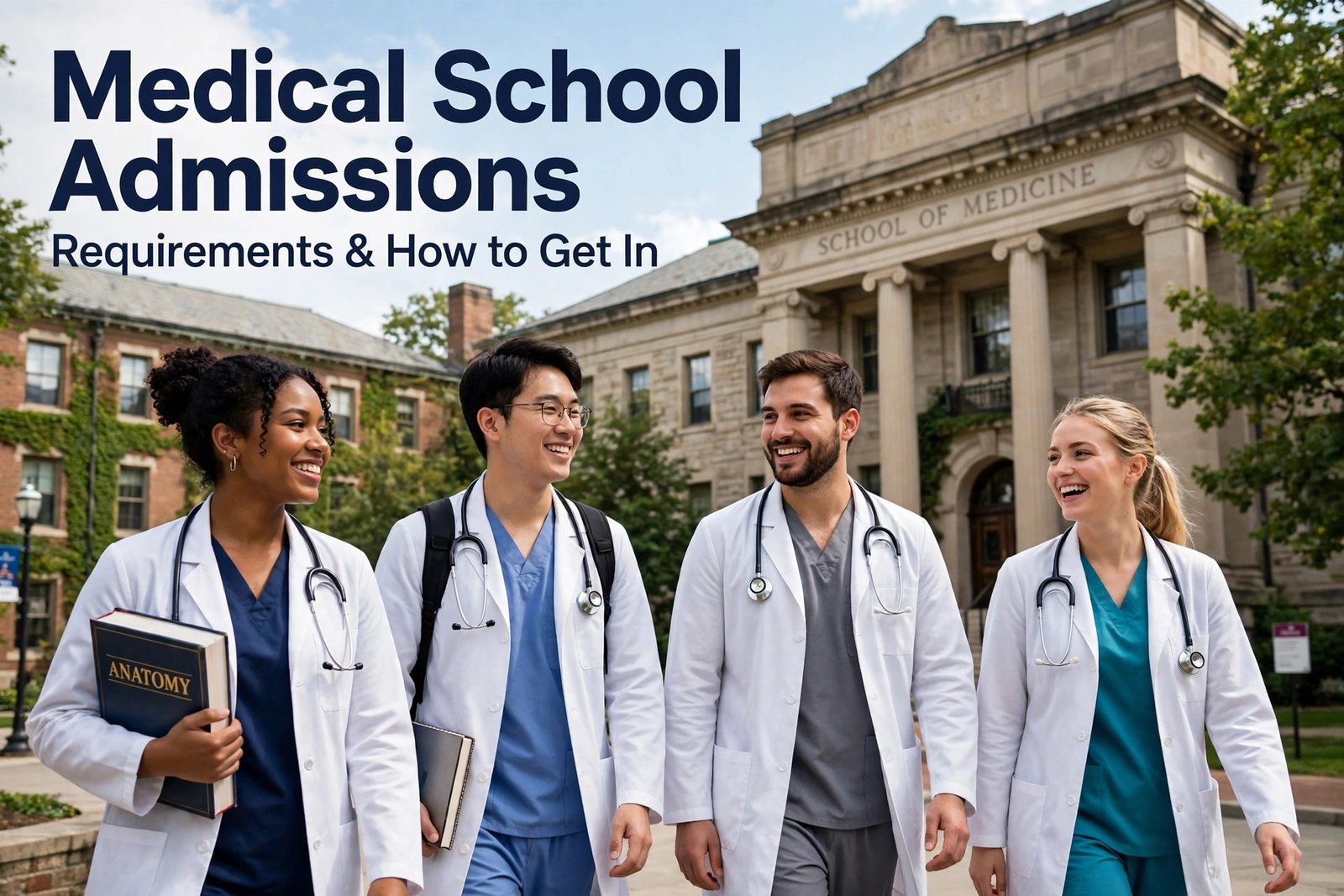
Getting into medical school in the United States is one of the most competitive application processes in higher education. Every year, tens of thousands of qualified students apply for a limited number of seats, and admissions committees review far more than grades and test scores. The good news is that the process is structured and predictable: if you understand what schools require and build your application step by step, you can present yourself as a strong, well-prepared candidate. This guide explains how medical school admissions works, what committees look for, and how to get in.
How Medical School Admissions Works
Most U.S. medical schools grant the MD degree, while a smaller number of osteopathic schools grant the DO degree. Both produce fully licensed physicians. Most MD schools use the AMCAS application service, run by the Association of American Medical Colleges, while most DO schools use AACOMAS. A small number of schools, including those in Texas, use their own systems.
Choosing between MD and DO programs is mostly a matter of fit and geography rather than prestige. DO schools add training in osteopathic manipulative medicine and often emphasize primary care, but their graduates enter the same residency system, take comparable licensing paths, and practice in every specialty. Many applicants apply to both types of schools to widen their options.
The cycle follows a familiar pattern. You submit one primary application with your coursework, experiences, personal statement, and MCAT score. Schools review it and send selected applicants a secondary application with school-specific essays. After that, chosen candidates are invited to interview. Decisions roll out over several months. Because many schools review applications as they arrive, applying early in the cycle is a genuine advantage.
Academic Requirements
Nearly every medical school requires a bachelor’s degree before enrollment, but it does not have to be in biology or any particular major. What matters is completing the prerequisite courses, which typically include:
- One year of general biology with labs
- One year of general chemistry with labs
- One year of organic chemistry with labs
- One year of physics with labs
- Biochemistry (required or strongly recommended by most schools)
- English or writing-intensive coursework
- Mathematics or statistics, plus psychology and sociology for many schools
Admissions committees look closely at both your overall GPA and your science GPA, which AMCAS calculates separately from biology, chemistry, physics, and math courses. There is no single cutoff that applies everywhere, but competitive applicants generally present strong grades, especially in the sciences, along with an upward trend when early semesters were weaker.
The MCAT Requirement
Almost all U.S. medical schools require the Medical College Admission Test (MCAT), a standardized exam that tests science knowledge, reasoning, and critical thinking. The MCAT has four sections and a total score range of 472 to 528. Schools weigh your score alongside your GPA as the two main academic measures of readiness for a demanding curriculum.
Because the exam covers material from your prerequisite courses, most students take it after finishing biology, chemistry, physics, and biochemistry — often in the spring of the year they apply. Our full breakdown of the MCAT format, scoring and preparation strategy explains exactly what the test covers and how to build a study plan that fits your schedule.
Experience: Clinical Exposure, Shadowing and Service
Grades prove you can handle the coursework. Experience proves you understand the profession you are entering. Admissions committees expect applicants to have tested their commitment to medicine in real settings, and the strongest applications usually include several of the following:
- Clinical experience: paid or volunteer roles where you interact with patients, such as hospital volunteering, medical scribing, EMT work, or medical assisting.
- Physician shadowing: observing doctors in different specialties to understand daily practice and confirm your fit.
- Community service: sustained volunteering, especially with underserved populations, shows the service orientation schools value.
- Research: lab or clinical research is valued, particularly by research-focused schools, though it is not mandatory everywhere.
- Leadership: roles in student organizations, tutoring, or employment that show responsibility and teamwork.
Quality and reflection matter more than raw hours. A long-term commitment you can write about thoughtfully beats a long list of one-off activities.
The Application Components
Beyond academics and experience, your application tells a story. The personal statement is your chance to explain, in your own voice, why you want to become a physician and what experiences shaped that decision. Letters of recommendation — usually from science professors and a physician or research mentor — give committees an outside view of your character and ability. The activities section lets you describe up to fifteen experiences and highlight the most meaningful ones.
Secondary applications add short essays tailored to each school, so research every school you apply to and answer for that school specifically. Interviews, whether traditional or in the multiple mini-interview (MMI) format, assess communication, ethics, and maturity. Treat them as conversations, not interrogations.
Start With the Right Foundation
Successful applicants rarely assemble everything in one semester. They plan their coursework early, gather experience over several years, and leave time to prepare properly for the MCAT. If you are still in the early stages, following a clear plan for your pre-med requirements, from courses to experience, will keep each piece of the application on track so nothing is rushed at the end.
Frequently Asked Questions
How long does it take to become a doctor after medical school admission?
Medical school itself lasts four years. After graduation, new physicians complete residency training in their chosen specialty, which takes at least three years and longer for surgical fields, before practicing independently.
Can I get into medical school with a non-science major?
Yes. Medical schools accept students from many majors, including humanities and social sciences, as long as the prerequisite science courses are completed with strong grades and the rest of the application is competitive.
When should I submit my application?
As early as you reasonably can. AMCAS typically opens for submission in late spring, and because many schools use rolling admissions, earlier verified applications are often reviewed — and interviewed — sooner.
Key takeaway: Medical school admissions rewards preparation, not perfection. Complete the prerequisites with strong grades, prepare seriously for the MCAT, build genuine clinical and service experience, and apply early with a thoughtful, honest application.
1 thought on “Medical School Admissions: Requirements and How to Get In”