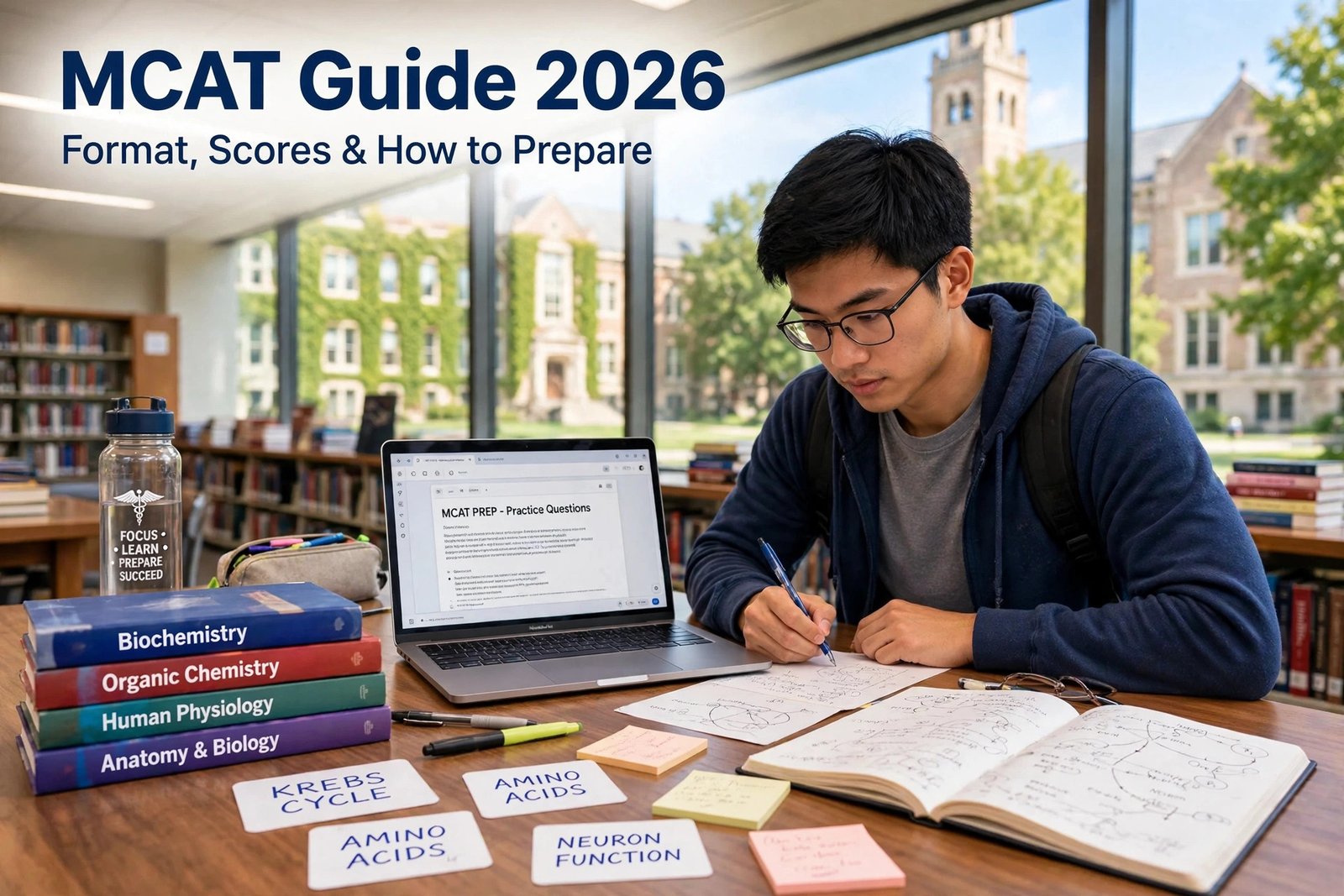
The MCAT is the one part of the medical school application that every applicant faces on equal terms: same sections, same scoring scale, same high stakes. A strong score can open doors across the country, while a weak one can close them even for students with excellent grades. This guide explains the MCAT format for 2026, how scoring works, when to take the test, and how to prepare in a way that actually raises your score.
What Is the MCAT?
The Medical College Admission Test is a standardized, computer-based exam developed by the Association of American Medical Colleges (AAMC). Nearly all MD programs in the United States require it, and most DO programs accept it as well. The exam is offered many times throughout the year at testing centers nationwide, and it is a long test: with breaks, the full testing day runs about seven and a half hours.
The MCAT is not a test of memorized facts alone. It is designed to measure whether you can apply scientific concepts to unfamiliar problems, reason through data, and read critically — the same skills the first years of medical school demand.
The Four MCAT Sections
The exam is divided into four sections, each built around passage-based questions plus some discrete questions:
- Chemical and Physical Foundations of Biological Systems: general chemistry, organic chemistry, physics, and biochemistry applied to living systems.
- Critical Analysis and Reasoning Skills (CARS): passages from humanities and social sciences tested purely on reading and reasoning; no outside knowledge required.
- Biological and Biochemical Foundations of Living Systems: biology and biochemistry, with supporting general and organic chemistry concepts.
- Psychological, Social, and Biological Foundations of Behavior: psychology, sociology, and related biology covering behavior and society.
Three of the four sections draw directly on your prerequisite coursework, which is why students usually take the MCAT after completing biology, chemistry, physics, and biochemistry.
MCAT Scoring Explained
Each of the four sections is scored from 118 to 132, and the four scores add up to a total between 472 and 528. A score of about 125 per section, or roughly 500 overall, sits near the middle of the scale. Scores are reported with percentiles so schools can see how you performed relative to other test takers in recent years.
There is no penalty for wrong answers, so you should answer every question. Admissions committees typically see all of your scores if you test more than once, and policies on using the highest or most recent score vary by school — one more reason to take the exam once, when you are truly ready. Scores remain valid for about two to three years at most schools, though each school sets its own limit.
When Should You Take the MCAT?
Timing matters in two ways. First, you should only test after finishing the coursework the exam draws on; testing before organic chemistry or biochemistry usually means teaching yourself large amounts of material under time pressure. Second, your score needs to be available when applications open. Students who plan to apply in the summer after their junior year commonly test in the winter or spring of that year, leaving a buffer to retake if illness or a bad day strikes.
Remember that a test date is a commitment to a study plan. If your practice scores are nowhere near your goal a few weeks out, postponing is usually wiser than hoping test day goes differently. Fitting the exam into your wider application plan is easier when you can see how it connects to the rest of the medical school admissions requirements and timeline.
How to Prepare for the MCAT
Effective preparation has three phases, and skipping any of them is the most common reason scores stall.
Phase 1: Content Review
Work through the official AAMC content outline and rebuild your foundation in each subject. Use a structured resource — books, a course, or video lessons — and take notes actively rather than rereading. CARS is the exception: it improves through daily passage practice, not content study.
Phase 2: Deliberate Practice
Shift to questions early and often. Do passages under timed conditions, then review every question — right and wrong — until you understand the reasoning. Keep an error log of why you missed questions: content gaps, misread questions, or timing problems each need a different fix.
Phase 3: Full-Length Practice Exams
In the final stretch, take full-length practice exams under real conditions: same start time, same breaks, no pausing. The official AAMC practice exams are the most representative, so save them for this phase and treat your scores on them as the best predictor of test day. Many students prepare over several months alongside classes or work, studying consistently in shorter daily sessions rather than in occasional marathons.
Test Day and After
In the final week, taper your studying, confirm your test center logistics, and protect your sleep. On test day you will have the option to void your score before leaving, but this should be reserved for genuine emergencies such as illness — not for a vague feeling that a section went badly.
Scores are released about a month after the exam. If your score falls well short of what your target schools expect and your practice tests showed you can do better, a retake with a changed preparation strategy can be reasonable. This decision is easier to make when your coursework and experience are already in order, which is exactly what a solid plan for your pre-med requirements — courses, GPA and experience is designed to give you.
Frequently Asked Questions
How many times can I take the MCAT?
The AAMC sets limits: you can test up to three times in a single testing year, four times across two consecutive years, and seven times in a lifetime. Most successful applicants test once or twice.
What is a good MCAT score?
“Good” depends on the schools you target. A score above the midpoint of the 472–528 scale is competitive at many programs, while the most selective schools expect scores near the top of the range. Always compare your score with each school’s published class profile.
How long is the MCAT?
The exam contains about six hours of actual testing time, and with check-in, breaks, and administrative steps, you should expect to spend roughly seven and a half hours at the test center.
Key takeaway: The MCAT rewards a plan, not panic. Finish your prerequisite courses first, build preparation around the four sections, practice under real conditions with official materials, and schedule the test so your score is ready when applications open.