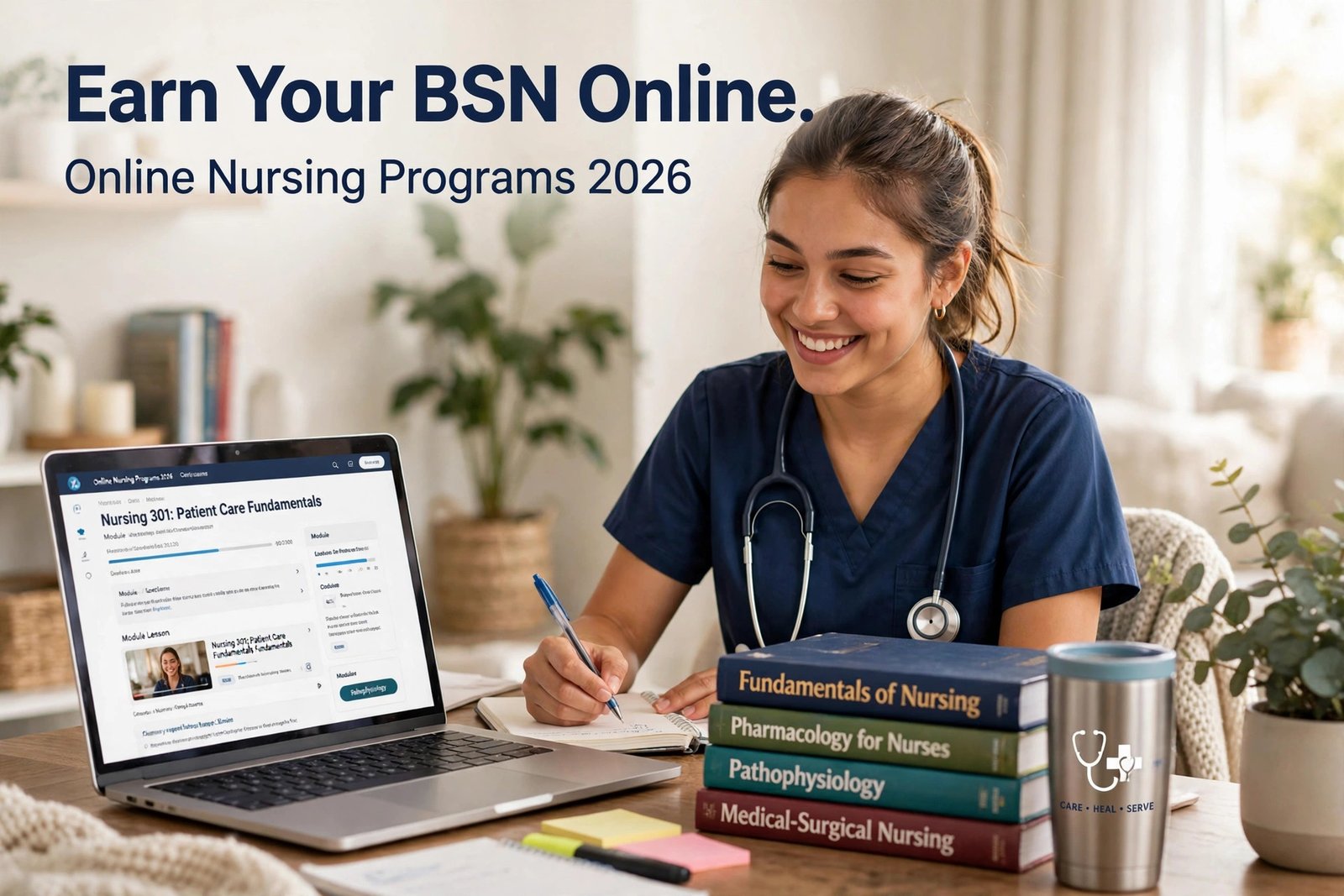
Not long ago, earning a nursing degree meant relocating or commuting to campus for every lecture. Today, accredited universities across the United States deliver much of the BSN curriculum online, making it possible to study from home while completing hands-on training in your own community. But “online nursing program” can mean very different things depending on where you are in your career — and one part of nursing education can never be done at a keyboard. This guide explains how online nursing programs actually work in 2026, who they fit, what they cost, and how to choose a legitimate program that qualifies you for licensure.
Can You Really Earn a BSN Online?
Yes — with one important clarification. Nursing has two components: didactic coursework (lectures, readings, assignments, exams) and clinical training (supervised patient care in real healthcare settings). Coursework can be delivered fully online. Clinicals cannot. Every legitimate pre-licensure nursing program, online or not, requires hundreds of hours of in-person clinical practice, because state boards of nursing will not license a nurse who has never cared for real patients.
So an “online BSN” is really a hybrid: theory online, clinicals in person at hospitals and clinics near you. Any website promising a nursing license with zero in-person training is not a real pathway to licensure — walk away.
The Three Types of Online Nursing Programs
1. RN-to-BSN programs (fully online)
If you are already a licensed RN with an associate degree, RN-to-BSN programs are designed for you and are commonly 100% online, since you have already completed clinical training. They add coursework in leadership, evidence-based practice, and community health. Many working nurses finish in about 12 to 24 months of part-time study. If this is your situation, our detailed breakdown of RN to BSN programs, costs and timelines covers exactly what to expect.
2. Pre-licensure online BSN programs (hybrid)
These programs admit students with no nursing license. Lectures and assignments are online, while labs and clinical rotations happen in person — the university either partners with facilities near you or helps you secure placements. They suit career changers and students far from a campus, but they still require a real time commitment for on-site hours.
3. Accelerated online BSN programs
For people who already hold a bachelor’s degree in another field, some universities offer accelerated BSN tracks with online coursework and intensive in-person clinicals, typically completed in about 12 to 18 months.
How Online Clinical Placements Work
Clinical placement is the detail that makes or breaks an online program. Schools handle it in different ways:
- School-arranged placements: the university has contracts with facilities in your area and assigns your rotations.
- Student-sourced placements: you find a facility and preceptor, and the school approves and formalizes the agreement.
Before enrolling, ask exactly which model the school uses, how far students typically travel to clinical sites, and whether placement support is included. Also confirm the program is authorized to enroll students in your state — universities must be approved in each state where their students complete clinicals, and a program that cannot place you in your home state is useless to you.
How Much Time Does Online Study Take Each Week?
A common misconception is that online coursework demands less time than campus classes. In reality, the credit hours are the same, and a useful rule of thumb is to expect roughly two to three hours of study per week for every credit hour you take — reading, discussion posts, papers, and exam preparation included. A student carrying nine credits in a term should plan on a workload comparable to a part-time job, on top of any scheduled clinical days. Students who succeed online tend to treat study time as fixed appointments in their calendar, use the program’s tutoring and advising resources early rather than after falling behind, and front-load assignments in weeks without clinical rotations. If you are working while studying, start with a lighter first term and increase your load only once you know how the rhythm feels.
Accreditation: The Non-Negotiable Checklist
An online BSN is only worth earning if it leads to a license and is respected by employers. Verify all three of the following:
- Regional accreditation of the university itself, so your credits and degree are recognized.
- Programmatic nursing accreditation by the Commission on Collegiate Nursing Education (CCNE) or the Accreditation Commission for Education in Nursing (ACEN).
- State board of nursing approval in the state where you will take the NCLEX-RN and work.
Graduating from an approved program is what makes you eligible for the licensing exam. Our step-by-step overview of how to become a registered nurse explains where the degree fits into the full licensing process.
What Does an Online BSN Cost?
Online tuition varies widely. Public universities generally charge less than private ones, and some schools offer a flat online rate regardless of your state of residence, while others charge out-of-state tuition. RN-to-BSN programs are usually the most affordable category because they are shorter and fully online. Pre-licensure hybrid programs cost more, reflecting lab and clinical coordination. Whatever the sticker price, apply for federal aid with the FAFSA first, then layer on scholarships and any employer tuition assistance — many hospitals help pay for their nurses’ BSN completion.
How to Choose the Right Program
- Confirm CCNE or ACEN accreditation and your state board’s approval.
- Ask how clinical placements are arranged and how far you may travel.
- Compare total cost, not just per-credit price, including fees.
- Check the program’s NCLEX pass rates, which schools are required to publish.
- Look for student support: tutoring, NCLEX prep, and a dedicated advisor.
- Decide on pace — self-paced competency formats exist for RN-to-BSN, while pre-licensure programs follow fixed terms.
Frequently Asked Questions
Will employers respect an online BSN?
Yes. Your diploma and license do not say “online.” Employers care that the program was accredited and that you passed the NCLEX-RN — the same standards as campus programs.
Can I get an RN license completely online?
No. You can complete coursework online, but clinical hours must be done in person, and the NCLEX-RN is taken at a testing center.
How long does an online BSN take?
RN-to-BSN programs often take 12 to 24 months part-time. A pre-licensure BSN generally follows a traditional multi-year structure, with accelerated options around 12 to 18 months for degree holders.
Is an online program easier than campus?
The academic standards and licensing exam are identical. Online study trades commuting for self-discipline — you must manage your own schedule without in-person classes.
Key Takeaways
- Online BSN coursework is online; clinical training is always in person.
- RN-to-BSN is the most flexible, fully online route for licensed nurses.
- Accreditation (CCNE/ACEN) and state board approval are essential checks before enrolling.
- Ask about clinical placement support and total cost before you commit.
1 thought on “Online Nursing Programs: How to Earn Your BSN Online in 2026”