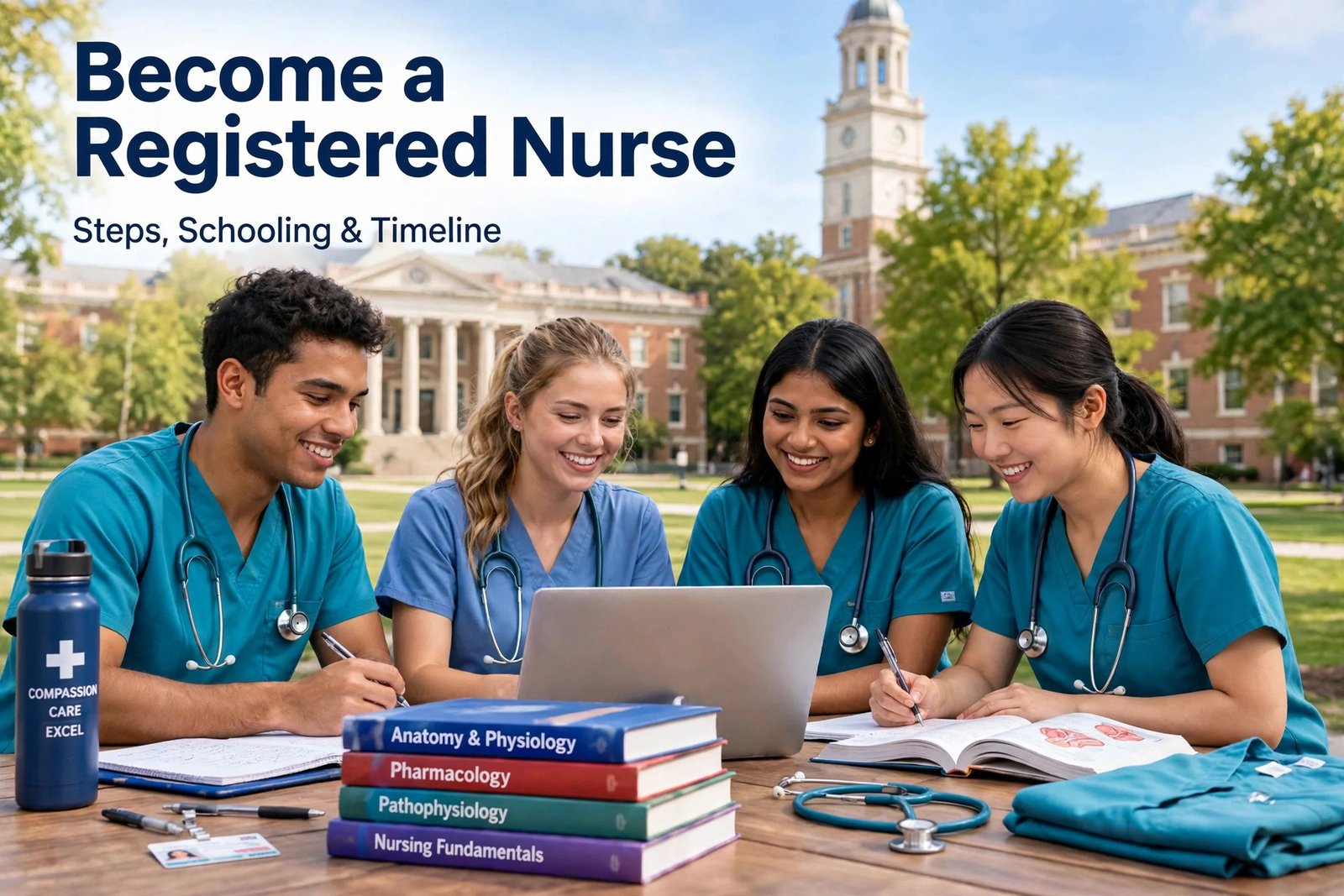
Registered nurses (RNs) are the backbone of the American healthcare system. They assess patients, administer medications and treatments, coordinate care with physicians, and educate patients and families in hospitals, clinics, schools, and community settings across the United States. If you want a stable, respected career that combines science with direct human impact, becoming an RN is one of the most reliable paths in healthcare. The good news: there is no single route in. This guide walks you through exactly how to become a registered nurse — the education options, the licensing exam, the costs, and a realistic timeline from your first prerequisite course to your first RN job.
Step 1: Choose Your Education Path — ADN or BSN
Every registered nurse in the U.S. must graduate from a state-approved nursing program and pass the national licensing exam. Two degree paths lead to the same RN license:
- Associate Degree in Nursing (ADN). Offered mainly by community colleges and some universities, an ADN typically takes about two years of full-time study after prerequisites. It is usually the fastest and most affordable route to the RN license.
- Bachelor of Science in Nursing (BSN). A four-year degree at a college or university. The BSN covers everything in an ADN plus leadership, research, public health, and management coursework. Many hospitals — especially large hospital systems and those pursuing or holding Magnet status — prefer or require the BSN for new hires, and a BSN is required later if you want to become a nurse practitioner or move into management.
Both ADN and BSN graduates sit for the same licensing exam and earn the same RN credential. Your choice mostly comes down to time, budget, and long-term goals. If you already hold a bachelor’s degree in another field, an accelerated BSN (ABSN) program can compress the nursing curriculum into roughly 12 to 18 months. If flexibility matters most, explore online nursing programs that lead to a BSN, which combine online coursework with in-person clinical placements near where you live.
Step 2: Complete the Prerequisite Courses
Before nursing programs will consider your application, you must complete a set of prerequisite courses, usually with a minimum GPA. Common prerequisites include:
- Human anatomy and physiology (usually two semesters, with labs)
- Microbiology (with lab)
- General chemistry
- Statistics
- General psychology and human growth and development
- English composition and nutrition
Nursing admissions are competitive at many schools, so strong grades in the science prerequisites matter. Some programs also require an entrance exam such as the TEAS (Test of Essential Academic Skills) or HESI A2, a background check, immunizations, and CPR certification before clinical placements begin.
Step 3: Graduate From an Accredited Nursing Program
During nursing school you will split your time between classroom (or online) coursework and clinical rotations — supervised, hands-on patient care in hospitals and other healthcare facilities. Coursework covers pharmacology, medical-surgical nursing, maternal and child health, psychiatric nursing, and community health. Accreditation matters: look for programs accredited by the Commission on Collegiate Nursing Education (CCNE) or the Accreditation Commission for Education in Nursing (ACEN), and approved by your state board of nursing. Graduating from an approved program is what makes you eligible to take the licensing exam.
Step 4: Pass the NCLEX-RN Exam
After graduating, you apply for licensure with your state board of nursing and register for the NCLEX-RN, the national licensing examination administered by the National Council of State Boards of Nursing (NCSBN) through Pearson VUE testing centers. The NCLEX-RN is a computerized adaptive test: the questions adjust in difficulty based on your answers. Under the current Next Gen NCLEX format, candidates answer a minimum of 85 questions and a maximum of 150, and the exam includes case-study items that test clinical judgment — how you would actually prioritize and respond in real patient scenarios. You will receive a pass/fail result, and most candidates learn their unofficial outcome within a couple of days. If you do not pass, you can retake the exam after a waiting period set by NCSBN (45 days between attempts, up to eight attempts per year).
Step 5: Get Licensed and Start Working
Once you pass, your state board of nursing issues your RN license and you can legally work as a registered nurse. Many new graduates start in hospital medical-surgical units, but RNs also work in emergency departments, intensive care, pediatrics, public health, home health, and outpatient clinics. If you plan to move states later, note that most states participate in the Nurse Licensure Compact (NLC), which lets you hold one multistate license and practice in other compact states without applying for a separate license in each.
How Long Does It Take to Become an RN?
- ADN route: roughly 2 to 3 years including prerequisites
- Traditional BSN: roughly 4 years
- Accelerated BSN: roughly 12 to 18 months (requires an existing bachelor’s degree)
- Licensing: add a few weeks to a few months for NCLEX scheduling, results, and state processing
What Does Nursing School Cost?
Costs vary enormously by school type. Community college ADN programs are typically the least expensive option, public university BSN programs sit in the middle, and private universities are the most expensive. Beyond tuition, budget for textbooks, uniforms and clinical supplies, exam and licensing fees, and transportation to clinical sites. The financial side is manageable with planning: federal student aid (starting with the FAFSA), state grants, employer tuition programs, and nursing-specific aid can cut the bill significantly. Start by reviewing these scholarships for nursing students to see what you may qualify for before taking on loans.
Frequently Asked Questions
Can I become an RN without a degree?
No. Every state requires graduation from an approved nursing program — at minimum an associate degree — plus a passing NCLEX-RN score before issuing an RN license.
Is the ADN or BSN better?
Both lead to the same license and exam. The ADN is faster and cheaper; the BSN opens more doors with large hospital systems and is required for graduate study. Many ADN nurses complete an RN-to-BSN bridge program later while working.
How hard is the NCLEX-RN?
It is challenging by design because it tests clinical judgment, not just memorization. Graduates of accredited programs who prepare with practice questions and case studies pass at strong rates, and retakes are allowed if needed.
Can I work while in nursing school?
Many ADN and BSN students work part-time, though clinical schedules can be unpredictable. Accelerated programs are usually too intensive to allow significant work hours.
Key Takeaways
- Choose an ADN (about 2 years) for speed and cost, or a BSN (about 4 years) for broader career options.
- Complete science prerequisites with strong grades to stay competitive for admission.
- Graduate from a state-approved, accredited program and pass the NCLEX-RN to earn your license.
- Plan your budget early with financial aid and scholarships so cost never becomes the barrier.
1 thought on “How to Become a Registered Nurse: Steps, Schooling and Timeline”