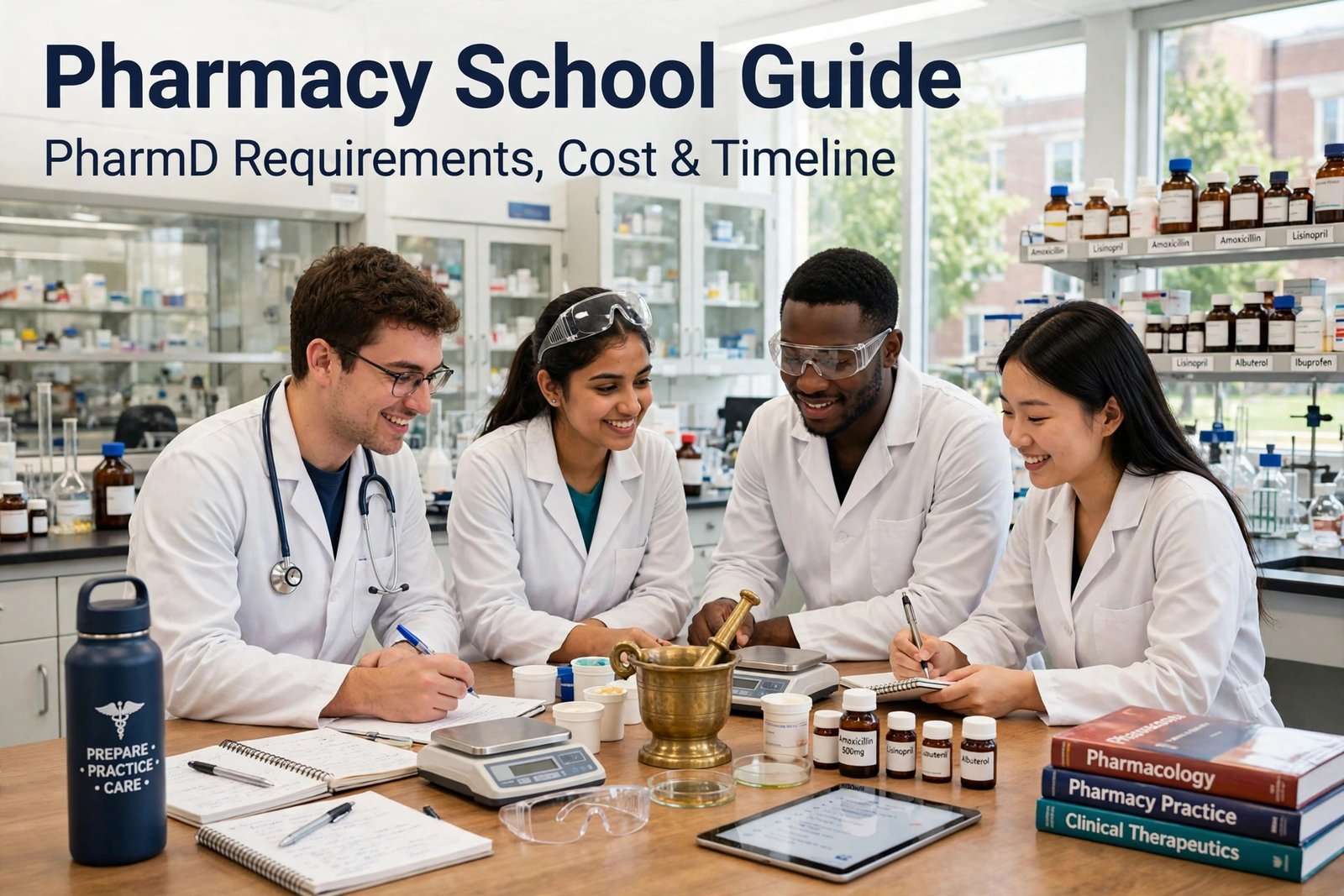
Pharmacists are among the most accessible healthcare professionals in America, and every one of them starts in the same place: a Doctor of Pharmacy (PharmD) program. If you are considering pharmacy school, you need clear answers about what it takes to get in, what it costs, and how long it takes to go from applicant to licensed pharmacist. This guide covers all three — the requirements, the cost picture, and a realistic year-by-year timeline.
What Is a PharmD?
The PharmD is the professional doctorate required to become a licensed pharmacist in the United States. It replaced the bachelor’s degree in pharmacy as the entry-level credential, reflecting how the profession has shifted from dispensing medication toward direct patient care: medication therapy management, immunizations, chronic disease support, and clinical decision-making alongside physicians and nurses.
PharmD programs are accredited by the Accreditation Council for Pharmacy Education (ACPE). Graduation from an accredited program is a requirement for licensure in every state, so accreditation status is the first thing to verify on any school’s website.
Pharmacy School Requirements
Admission requirements are set by each school, but a standard application package looks like this:
- Prerequisite coursework: typically two or more years of college study covering general chemistry, organic chemistry, biology, anatomy and physiology, microbiology, physics, calculus, statistics, and English/humanities courses.
- Degree expectations: some programs admit students after the prerequisite years (sometimes called 0-6 or early-assurance pathways), while many students — and some schools — prefer or require a completed bachelor’s degree.
- Application service: most schools use PharmCAS, the centralized application, through which you submit transcripts, letters of recommendation, and a personal statement.
- Entrance exams: the PCAT admission test has been discontinued, and most pharmacy schools no longer require any standardized entrance exam — always confirm with each school.
- Experience: pharmacy technician work or shadowing is rarely mandatory but strengthens an application and confirms the career fit.
Because requirements vary more in pharmacy than in many health professions, build your school list early and map your undergraduate courses against each program’s prerequisite list.
How Much Does Pharmacy School Cost?
There is no single national price for a PharmD, and honest guidance starts there. Total tuition depends heavily on three factors: whether the school is public or private, whether you qualify for in-state tuition, and the cost of living where the program is located. Public in-state programs sit at the lower end, while private programs can cost several times more per year — across four years, the difference in total debt can be enormous.
When you compare schools, look beyond the headline tuition and add fees, books and equipment, professional liability insurance, background checks and immunizations, and living expenses. Then think about financing early: federal student loans are the main funding source for most pharmacy students, supplemented by school scholarships and, for some, employer or military service programs. Our guide to student loans for nursing and medical school walks through the same federal loan options pharmacy students use, including Direct Unsubsidized Loans and Grad PLUS Loans, and explains how to borrow only what you need.
The PharmD Timeline: Four Years
A traditional PharmD program runs four academic years after the pre-pharmacy requirements. Some schools offer three-year accelerated formats that run year-round; the curriculum is the same, compressed into fewer calendar months.
- Year 1: foundations — pharmaceutics, medicinal chemistry, physiology, pharmacy law and ethics, plus early practice experiences in real pharmacies (IPPEs).
- Year 2: pharmacology and pharmacotherapy sequences begin, covering major disease states and drug classes, with continued practice hours.
- Year 3: advanced therapeutics, patient assessment, and preparation for full-time rotations; IPPEs continue.
- Year 4: advanced pharmacy practice experiences (APPEs) — full-time clinical rotations in settings such as hospitals, community pharmacies, ambulatory care, and specialty practices.
After graduation, the path to practice is short compared with many health professions: pass the licensing exams and you can work as a pharmacist. Residency is optional but increasingly expected for hospital and clinical specialist roles.
Licensing: The NAPLEX and Law Exams
Two exam hurdles stand between graduation and practice. The North American Pharmacist Licensure Examination (NAPLEX) tests the knowledge and judgment needed for safe pharmacy practice, and nearly every state requires it. Most states also require a jurisprudence exam — the MPJE or a state-specific law test — covering the federal and state laws that govern pharmacy. Once you pass and meet your state board’s requirements (most include an application, background check, and in some states internship hours earned during school), you receive your license.
Residencies and Career Paths
A PharmD opens more doors than the neighborhood pharmacy counter. Community pharmacy remains the largest employer, but pharmacists also work in hospital and health-system pharmacy, ambulatory care clinics, long-term care, the pharmaceutical industry, health insurance and pharmacy benefit management, government agencies, and academia. Postgraduate residencies — a first year (PGY1) and optional specialized second year (PGY2) — are the standard route into competitive clinical and hospital positions, and they also build the medication-therapy expertise that modern employers prize.
If you are still deciding between health professions, it can help to set pharmacy beside a neighboring option and compare training length, application structure, and day-to-day work. Our breakdown of medical school admissions requirements shows how the longer physician pathway is organized; pharmacy delivers doctoral-level clinical training on a shorter, more direct timeline.
Frequently Asked Questions
How long does it take to become a pharmacist?
Plan on about six to eight years after high school: at least two years of prerequisite coursework (four if you complete a bachelor’s degree first), followed by the four-year PharmD program, then licensing exams.
Do I need a bachelor’s degree for pharmacy school?
Not always. Some programs admit students after the prerequisite courses are complete, and a few offer direct-entry pathways from high school. However, a growing number of schools prefer bachelor’s-prepared applicants, so check each target school.
Is pharmacy school hard to get into?
Admission competitiveness varies widely by school. Meeting prerequisites with solid grades, gaining pharmacy experience, and applying through PharmCAS with a thoughtful personal statement will make you competitive at many programs.
Key takeaway: The PharmD route is one of the most direct doctoral paths in healthcare: complete the science prerequisites, apply through PharmCAS, finish a four-year accredited program, pass the NAPLEX and your state law exam, and you are a licensed pharmacist. Choose your school with total cost in mind, because the degree is the same license at every price point.