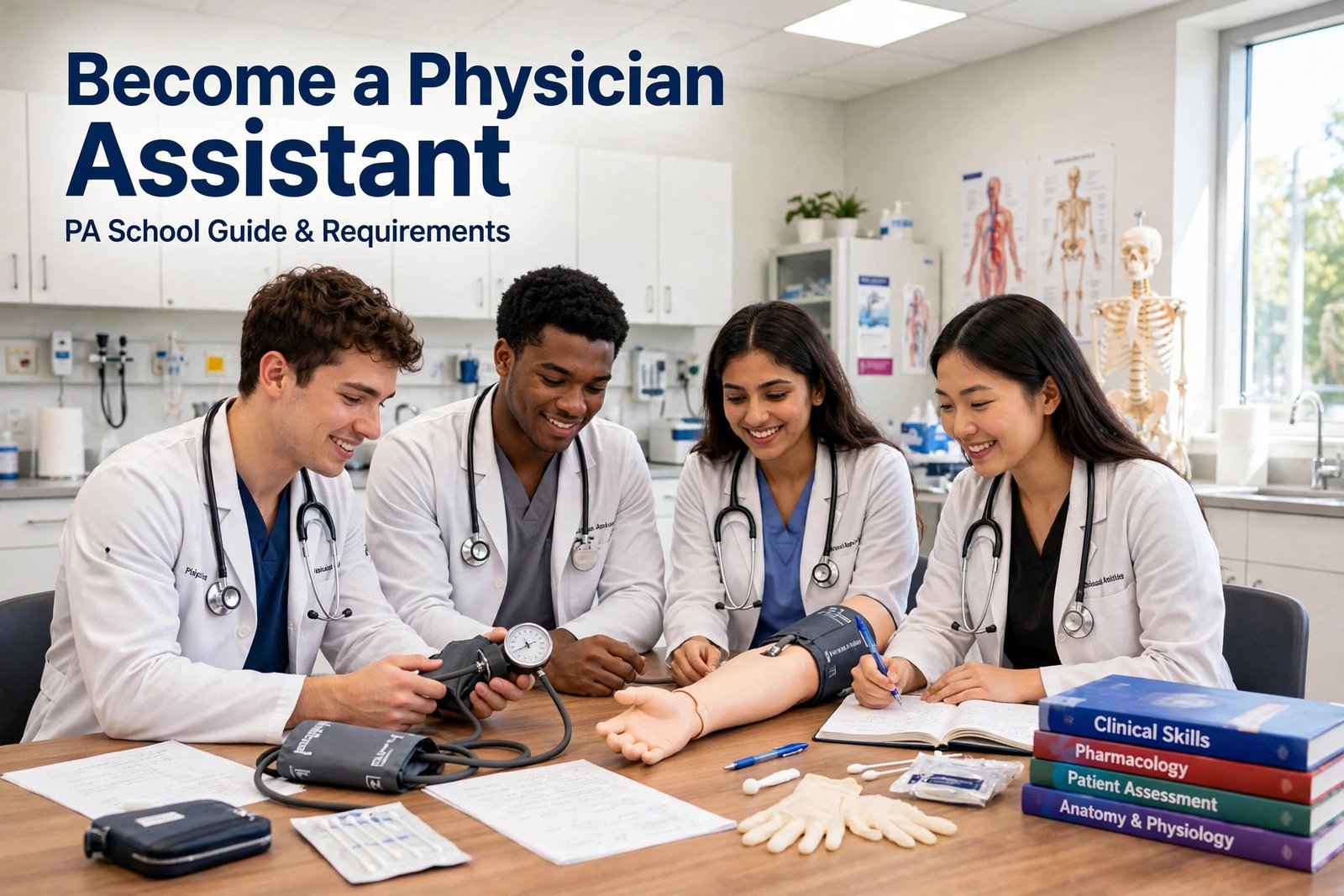
If you want to practice medicine, treat patients, and join a healthcare team without spending a decade in training, the physician assistant (PA) path deserves a serious look. PAs are licensed medical professionals who diagnose illness, develop treatment plans, and prescribe medication in nearly every specialty and setting. This step-by-step guide explains how to become a physician assistant in the United States — the degree, the experience, PA school itself, and the certification that follows.
What Does a Physician Assistant Do?
Physician assistants — also called physician associates — work in hospitals, clinics, surgical suites, emergency departments, and private practices. Depending on the setting and state law, a PA’s day may include taking medical histories, performing physical exams, ordering and interpreting tests, diagnosing conditions, assisting in surgery, and prescribing medications.
PAs practice in collaboration with physicians, but the day-to-day work involves substantial independence: many PAs manage their own patient panels and make clinical decisions throughout the day. The role was built for flexibility, so PAs can also switch specialties during their careers without returning to school.
Step 1: Earn a Bachelor’s Degree and Complete Prerequisites
PA programs are graduate programs, so you first need a bachelor’s degree in any field. Most applicants choose health- or science-related majors because PA schools require specific prerequisite courses, typically including:
- Anatomy and physiology
- General chemistry and often organic chemistry or biochemistry
- Biology and microbiology
- Psychology
- Statistics
- Medical terminology at many programs
Each program publishes its own list and minimum GPA expectations, so check target schools early — ideally before choosing your undergraduate courses — to avoid expensive surprises later.
Step 2: Gain Hands-On Patient Care Experience
This is the step that separates PA admissions from most other graduate applications. PA programs were designed for people who have already worked with patients, and many programs require or strongly prefer substantial paid patient care experience. Common qualifying roles include:
- Emergency medical technician (EMT) or paramedic
- Medical assistant
- Certified nursing assistant (CNA)
- Medical scribe, phlebotomist, or respiratory therapist
- Military medic or corpsman experience
Many of these entry roles start with a short training program and a certificate rather than a degree, which makes them realistic jobs to hold during or right after college. Our overview of healthcare certifications that pay well is a useful starting point for comparing these roles, their training length, and which ones PA programs tend to value most.
Step 3: Apply Through CASPA
Most PA programs recruit through CASPA, the centralized application service for the profession. Through one portal you submit transcripts, your experience record, letters of recommendation, and a personal statement explaining why you want to become a PA. Many programs also require an interview, and some require the PA-CAT or GRE admissions tests, though requirements differ widely by school.
Admission is competitive — programs receive far more qualified applications than they have seats — so apply broadly, apply early in the cycle, and make sure your experience hours are documented exactly as each program counts them.
Step 4: Complete a PA Program
PA programs are full-time, graduate-level programs that typically take about 24 to 27 months and award a master’s degree. The curriculum is usually split into two phases:
- Didactic phase: roughly the first year, spent in classroom and lab study — anatomy, pharmacology, physiology, clinical medicine, diagnostics, and patient assessment.
- Clinical phase: a series of supervised rotations in fields such as family medicine, internal medicine, surgery, pediatrics, emergency medicine, and behavioral health.
The pace is intense and comparable in style to medical school coursework compressed into a shorter window. Students are generally advised not to work during the program.
Step 5: Pass the PANCE and Get Licensed
Graduation is not the finish line. To practice, you must pass the Physician Assistant National Certifying Exam (PANCE), administered through the National Commission on Certification of Physician Assistants (NCCPA). Passing earns you the PA-C credential. You then apply for a state license in the state where you will work. To maintain certification over your career, PAs complete continuing medical education and pass a recertification assessment on a regular cycle set by the NCCPA.
PA or Doctor: How the Paths Compare
Both PAs and physicians diagnose and treat patients, but the training differs sharply. The PA route takes roughly two to three years of graduate school after a bachelor’s degree plus clinical experience, while the physician route means four years of medical school followed by residency. Comparing the PA path with the medical school admissions requirements and training timeline side by side is the clearest way to see which structure fits your goals, finances, and desired lifestyle. Many strong candidates for one path would also thrive in the other — the right answer depends on how you want to spend your training years and your career.
Career Outlook and Flexibility
PAs are in demand across the healthcare system as practices and hospitals expand team-based care to serve more patients. The combination of a relatively short training period, broad specialty choice, and the ability to change specialties later makes the profession attractive to career changers as well as recent graduates. Whatever setting you choose — a rural family practice, a busy emergency department, or a surgical team — the credential travels with you.
Frequently Asked Questions
How long does it take to become a PA?
After a bachelor’s degree and the patient care experience most programs expect, PA school itself takes about 24 to 27 months. Many applicants spend one to three years building experience first, so plan on several years from undergraduate graduation to licensed practice.
Can I apply to PA school straight out of college?
You can apply if you meet a program’s requirements, but because most programs expect significant patient care experience, many successful applicants work in a clinical role for a year or more before applying.
Do PAs have to specialize?
No. PAs complete generalist training and can move between specialties during their careers, which is one of the profession’s most valued features. Additional fellowship training exists for PAs who want it in fields like emergency medicine or surgery.
Key takeaway: Becoming a PA is a five-step climb: bachelor’s degree with science prerequisites, real patient care experience, a competitive CASPA application, an intense two-year master’s program, and PANCE certification. Start with the experience step — it is the one applicants most often underestimate.
1 thought on “How to Become a Physician Assistant: PA School Guide”