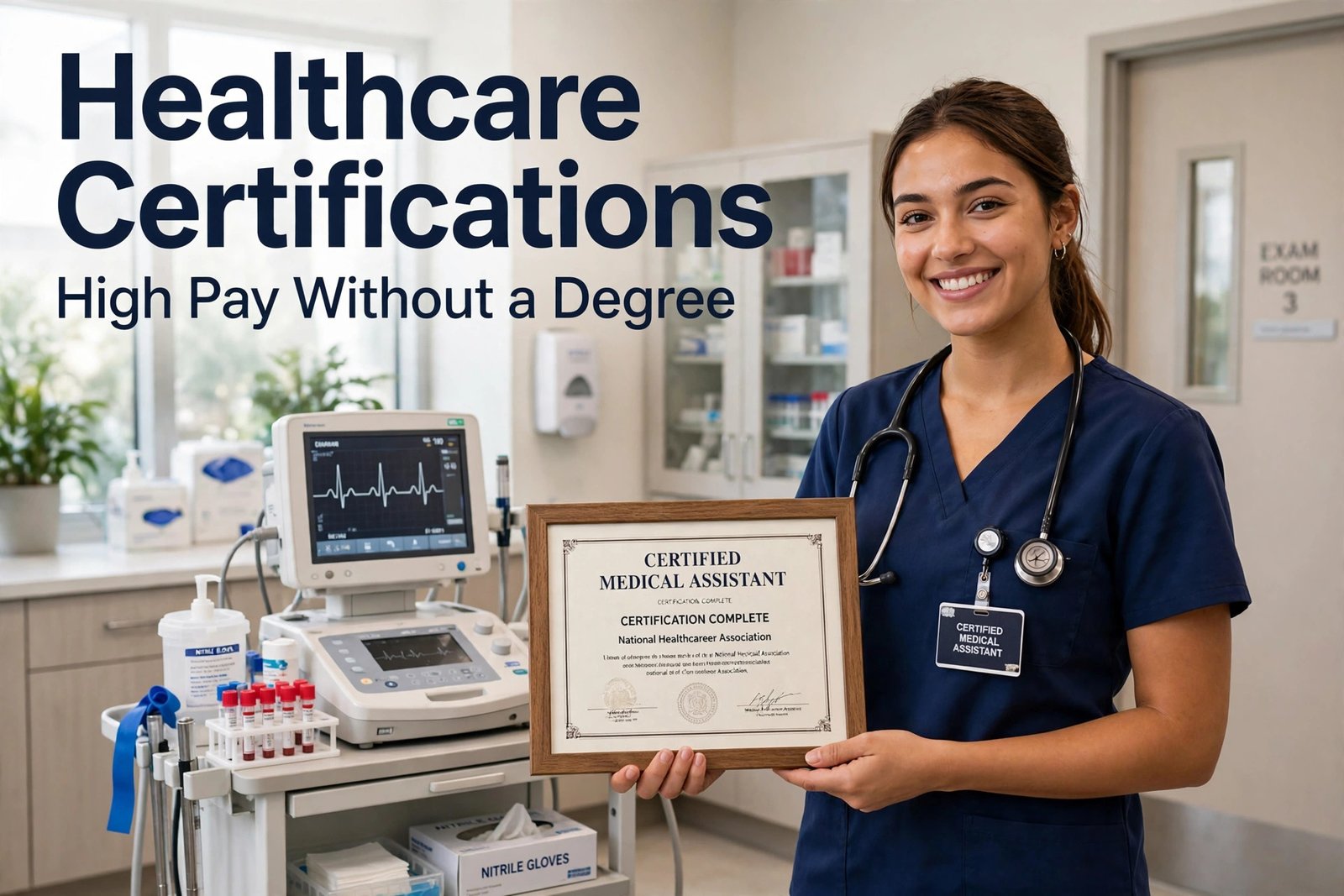
Not every well-paid healthcare job requires a college degree. Hospitals, clinics, labs, and dental offices run on certified technicians and specialists who trained for weeks or months rather than years, passed a national credentialing exam, and went to work. These certifications are also strategic: many people start in a certification job, earn while learning the healthcare system, and later stack the experience toward a degree and a license. This guide explains how healthcare certifications work and profiles the credentials that offer the strongest combination of pay potential, short training time, and real hiring demand.
How Healthcare Certifications Work
A certification pathway usually has three parts: a training program, which can run from a few weeks to about a year at a community college, technical school, or approved training provider; a certification exam run by a national credentialing organization; and, in some fields, a state registration or license on top of the national credential. Employers verify your credential before hiring, and most certifications require periodic renewal with continuing education. The key rule: confirm your program makes you eligible to sit for the recognized national exam in that field; if it does not, the certificate is just a piece of paper.
Certified Professional Coder (Medical Coding and Billing)
Medical coders translate diagnoses and procedures into the standardized codes (such as ICD-10 and CPT) that drive insurance billing. The best-known entry credential is the Certified Professional Coder (CPC) from the AAPC, earned by passing a comprehensive coding exam. Training programs typically take several months to about a year, including self-paced online options. Coding suits people who want detail-oriented, computer-based work, and a meaningful share of coding jobs are remote. Accuracy, anatomy knowledge, and familiarity with payer rules are what separate strong coders, and experienced coders can add specialty credentials over time.
Surgical Technologist
Surgical technologists prepare operating rooms, arrange sterile instruments, and assist the surgical team during procedures. The recognized credential is the Certified Surgical Technologist (CST), awarded by the National Board of Surgical Technology and Surgical Assisting (NBSTSA) to graduates of accredited programs who pass the certification exam. Training commonly runs from several months to two years, through certificate, diploma, or associate degree programs. It is one of the more demanding certification-track roles, and correspondingly one of the more respected in the operating room.
Phlebotomy Technician
Phlebotomists draw blood for tests, transfusions, and donations, and they are often a patient’s main point of contact in a lab visit. Training is among the shortest in healthcare, frequently a few weeks to a few months including supervised practice draws, with national certification available through organizations such as the NHA and ASCP. Some states, including California, have their own phlebotomy certification requirements, so check your state’s rules. Phlebotomy is rarely the final destination; it is an excellent, fast first credential that gets you employed in hospitals and labs while you decide on your next step.
Pharmacy Technician
Pharmacy technicians support pharmacists by preparing medications, managing inventory, and serving customers or hospital units. The standard national credential is the Certified Pharmacy Technician (CPhT) from the Pharmacy Technician Certification Board (PTCB), earned through an approved training pathway or qualifying work experience plus passing the certification exam. Most states also register or license pharmacy technicians, with requirements that vary. Hospital pharmacy techs and those who take on sterile compounding and other advanced duties generally have the strongest roles in this track.
Emergency Medical Technician (EMT)
EMTs provide emergency medical care at the scene and during ambulance transport. Training programs commonly run one semester or less and combine classroom instruction with clinical and field experience. Certification involves passing the National Registry of Emergency Medical Technicians (NREMT) cognitive and skills process, followed by state licensure. EMT work is physically and emotionally demanding, and it is excellent preparation for paramedic, nursing, and physician assistant programs, because few entry-level jobs teach patient assessment and composure as thoroughly.
Dental Assistant
Dental assistants keep dental practices running: preparing patients and rooms, passing instruments during procedures, taking X-rays where permitted, and handling sterilization and front-office tasks. The national credential is the Certified Dental Assistant (CDA) from the Dental Assisting National Board (DANB), and programs typically take nine months to about a year, though some states allow on-the-job training for entry-level duties. If you enjoy the dental setting and want to climb, assisting is also the perfect preview of the next step up: our guide on how to become a dental hygienist lays out the degree and licensing path.
EKG Technician, Patient Care Technician, and Medical Assistant
Three versatile credentials round out the list. EKG technicians operate electrocardiograph machines and support stress testing in hospitals and cardiology offices. Patient care technicians work at the bedside in hospitals, combining basic nursing care with skills like phlebotomy and EKG, which makes them highly employable. Medical assistants blend clinical tasks (vitals, injections, EKGs) with administrative work in clinics and physician offices. Credentials such as those from the National Healthcareer Association (NHA), including the CCMA for medical assistants, are widely recognized, and training for these roles usually takes from a few months to about a year.
How to Choose the Right Certification for You
Compare four things: total cost and training time, local hiring demand (search real job postings in your area before enrolling), the work setting you want, and how well the credential stacks. Bedside and lab credentials stack well toward licensed careers: phlebotomy and patient care experience strengthen a nursing application, and imaging is a classic step up, so if you are ready for a longer program with a strong payoff, see how to become a radiologic technologist. Whichever credential you choose, verify the training provider’s accreditation and exam-eligibility status first, be skeptical of any school that guarantees a job or pressures you to sign immediately, and confirm your state requirements before you pay tuition.
Frequently Asked Questions
How fast can I get a healthcare certification?
Timelines range from a few weeks for phlebotomy to about a year for medical coding, medical assisting, or surgical technology programs. State requirements and clinical schedules can add time, so confirm the full timeline with your program.
Do healthcare certifications expire?
Most do. National credentials typically require renewal on a set cycle along with continuing education. Keeping your credential active is part of staying employable, so track your renewal date from day one.
Which certification pays the most without a degree?
It varies by region, employer, and experience, but specialized and technical credentials, such as surgical technology and experienced medical coding, tend to sit at the stronger end of the pay range for non-degree roles. Shift differentials, overtime, and hospital versus clinic settings also move pay.
Key Takeaways
- Recognized national certifications, like the CPC, CST, CPhT, and CCMA, are what employers actually hire for; verify your program makes you exam-eligible.
- Training ranges from weeks to about a year, far shorter than a degree, with costs to match.
- Certifications in coding, surgical technology, pharmacy, and emergency care combine solid pay with real demand.
- Treat a certification as a first step you can stack toward licensed careers such as dental hygiene, radiologic technology, or nursing.
- Always confirm state rules and program accreditation before enrolling or paying tuition.